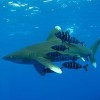

While most of the world’s dangerous sharks are found in the warm and temperate oceans and seas of the world, the question has often been asked “Are there dangerous sharks in British waters?”
The sea temperature around the British Isles can be considered to be temperate to cool, and are home to a huge variety of sharks, most of which are harmless.
Dangerous sharks abound in the US, South Africa, Australia and equatorial regions, but their presence around the British Isles largely absent or unrecorded.
According to Richard Peirce, chairman of the Shark Trust, conditions are right for the great white shark to appear in the coastal waters off Britain, although there has never been a confirmed sighting of one to date.
The most fearsome sea predator of all, the great white shark can easily kill us with just one bite. It is assumed that most times they bite us by accident, believing us to be a sea animal.
There have been reports of 12′ blue sharks being washed up on beaches with injuries consistent with having been attacked by a great white, but none have actually been spotted.
That is not to say a great white will never appear, as in 2011, the northeastern Russian port of Vladivostok suffered their first and second great white human maulings ever, those shark attacks being the first ever recorded off the cold northern Russian coastline.
It is also true to say that very few of the world’s top 10 most dangerous sharks have ever been spotted in British waters, except the odd summer visitor where it is quite likely that a faulty navigation system resulted in a lost and stray shark.
Nearly all sharks are dangerous up to a point, as all can give a nasty bite, but it is the the larger sharks that inflict the most damage, even when you are bitten accidentally as they mistake you for a seal or sea-lion.
Some big sharks never bite, the most notable among them being the basking shark, which is present in large numbers in British waters.
Let’s have a closer look at sharks considered to be dangerous that either live, or have been spotted, in the seas around the British Isles.
Oceanic White-Tip Sharks
An excitable fish, oceanic whitetips are mostly pelagic. This means that they prefer the open ocean, far from land.
Yet there has been a documented case of a fisherman coming face to face with one around the British Isles.
In June 2011, a fisherman claimed a 7 foot oceanic whitetip rammed his boat while he was fishing for mackerel off the coast of Cornwall, in south west England.
Without a photograph of the shark, it couldn’t be confirmed by shark experts to definitely be one, but the fisherman is reported to have said later that he had never witnessed such an aggressive shark in British coastal waters.
There are no other types of sharks that grow to 7 feet long, are aggressive, have white tips on the ends of their fins, and put their snouts above the water like this one did.
Oceanic whitetips are believed to be responsible for the deaths of up to 800 sailors from the SS Indianapolis and for eating many survivors of shipwrecks and air crashes that have landed in the warm tropical oceans of the world.
While this one may seem to be miles off-course, oceanic whitetips are frequently spotted in the Bay of Biscay which is only 200 miles from where this one was sighted.
Oceanic whitetip sharks are not typically aggressive except in the presence of food; then they become both excitable and aggressive.
As anyone who has ever fished for mackerel can tell you, mackerels travel in large shoals, so if you catch one, you can be sure you will catch quite a few more at the same session.
A shoal of mackerel would certainly set a hungry whitetip off, and it could well ram a boat or rise out of the water with excitement in the presence of mackerel.
As for the survivors of shipping or air disasters at sea, the presence of oceanic whitetips does not mean a certain death, unless someone is injured and bleeding, in which case the sharks may set off into a feeding frenzy, taking quick, small and frequent bites are anything that moves, causing death or severe injury.
The Nurse Shark
Another warm water fish which has been identified as present in the English Channel, which is the part of the Atlantic Ocean that separates England from continental Europe.
Nurse sharks normally prefers shallow waters of only 8 – 10 feet in depths, where by day they sleep under rocks, and come out at night to feed.
At those shallow depths, they may meet swimmers or divers and, while seemingly docile, can give a nasty bite, so are best avoided.
Nurse sharks are normally found in the tropical and subtropical oceans of the world where they can grow up to 14 feet (4.3m) in length, so it is somewhat surprising to find them in the cooler English Channel.
Sharpnose Sevengill Shark
Sharpnose sevengill sharks are vicious little creatures that are considered to be top predators of the deep oceans.
Growing to a maximum of 4.5 feet, they are frequently caught by deep sea fishermen as a by-catch, but are occasionally caught in shallow waters.
While not posing much of a risk to humans due to its diminutive stature, they can give a really nasty bite when caught and so are best avoided if at all possible.
There have been two recorded cases of sharpnose sevengills having been caught in British waters (which is normally considered to be too cold for their normal habitat) in recent times.
Both of those took place in the warmer sea areas off the British Isles – once off the south coast of Ireland and another time off the coast of Cornwall.
Shortfin Mako Shark
Shortfin mako sharks are summer visitors to British waters when the sea temperatures are nearer to their liking.
This can be a very dangerous fish, less so than oceanic whitetips or great whites, and it is indeed number 10 on the list of top 10 most dangerous sharks worldwide.
Shortfin makos have been responsible for 12 recorded unprovoked attacks on humans, and a further 30 provoked attacks, 3 of which turned out to be fatal.
Provoked attacks are those in which someone was actively fishing the shark at the time, or who had already caught it and perhaps brought it on board their boat.
Unfortunately for shortfin makos, which are an endangered species, their ability to leap an incredible 30′ (9m) out of the water and swim at up to 60mph has made them a favorite target of sports fishermen.
Their fins are also prized for shark’s fin soup, and so they are being fished to extinction.
Being largely pelagic (ocean-going), the shortfin mako will never come close to shore in British waters where there may be bathers, so are not going to be dangerous to anyone except those who wish them harm.
They are typically 7′ – 9′ in length.
Blue Sharks
Blue sharks can reach just over 12 feet (almost 4m) in length and are to be found in every sea and ocean worldwide.
While not considered to be dangerous while swimming free, if caught they fight for their lives and have been responsible for 4 fatalities.
They are present in British waters, though not in great numbers as they are suffering from the effects of overfishing, even though they are usually caught as a by-catch except when they are being fished for their fins for shark fins soup.
They are not often seen in coastal waters, although there have been reports of blue sharks being washed up dead or dying on beaches, even in the far north of Scotland.
Should you come across the carcass of a blue shark, or any other shark for that matter, do not be tempted to put your hand in its mouth because even after death they have a reflex that can snap their jaws shut, possibly taking your fingers with it!
Nursehound Sharks
Also known as the large spotted dogfish, nursehound sharks are only dangerous when caught.
Thanks to the cartilage they are made from (like all sharks) they can twist their bodies lightning quick and bite the hand that holds them.
Despite growing to a maximum of only 5 feet long (Heck! That’s big, that’s my height!), they can give a very nasty bite so extreme care has to be taken.
In a restaurant, nursehound sharks are served up as ‘rock salmon’, so you may have eaten one even if you are sympathetic to the plight of endangered sharks.
They are considered to be ‘near threatened’ which is a euphemism for “we don’t know if they are threatened or not, but we are catching an awful lot of them, so they might be”.
Angel sharks
Angel sharks look just like giant oversized flounders that hide themselves on the sea-bed in deeper waters.
If you are a diver and come across one, do not stand on it, even accidentally, as they can give a nasty bite when disturbed.
Angels sharks are called ‘monkfish’ on the menu and are critically endangered, so your chances of coming across one are quite remote.
However they are worth knowing about if you don’t want to end up in Casualty.
The above named sharks can all be found in British waters, and could be considered to be dangerous.
If you would like to see a full list of all 29 types of sharks that have been sighted in the seas and oceans around the British Isles, with a short introduction to each type of shark with an accompanying photograph, click on the link below.
Types of Sharks in British Waters
, Are There Dangerous Sharks in British Waters? www.ozeldersin.com bitirme tezi,ödev,proje dönem ödevi