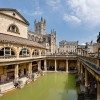

The beautiful city of Bath in Somerset is best known for its wonderful Georgian architecture and a fascinating complex called the Roman Baths. This complex was established by the Ancient Romans during their occupation of Britain and modified by later generations. It contains a natural hot spring, artificial pools that collect the spring water and special rooms related to the Ancient Roman ritual of taking a bath. It once contained an impressive temple as well.
The Ancient Roman used the baths as a spa and as a place to worship their goddess Sulis Minerva. The bath complex was famous and attracted many visitors from Britain and Europe. Before the Romans arrived in Britain, however, the hot spring that feeds today’s baths and the natural pool that it created were sacred for Celtic people. They believed that the goddess Sulis presided over the spring.
The Geothermal or Hot Springs of Bath
Bath is situated in the county of Somerset, which is located in South West England. The city contains the only natural hot springs in Britain. There are other geothermal springs in the country, but the temperature of their water is much lower.
There are three natural springs in Bath – the Sacred Spring, the Cross Bath Spring and the Hetling Spring. The Roman Baths owe their existence to the Sacred Spring, which is also known as the King’s Spring after King Henry 1. Artificial boreholes have created other springs in the city in addition to the natural ones.
1,170,000 litres of water (240,000 imperial gallons) at a temperature of 46 degrees Celsius (about 115 degrees Fahrenheit) are released from the sacred spring every day. This awesome output has been a daily occurrence for thousands of years. Today the water emerges in the Roman Bath complex. The overflow from the baths flows into the River Avon.
The springs in Bath are geothermal springs because their water is heated by activity below the Earth’s surface. Researchers say that the basic process involved is as follows. First, rain seeps into the ground and enters the limestone rocks underlying the countryside around Bath. The water is then heated by geological activity within the Earth. The heated water travels under pressure through fault lines or fractures in rock and emerges as a spring. The details of this process are still being deciphered. For example, although it’s often claimed that the water source of the spring is rain falling on the Mendip Hills, some researchers think that this is unlikely.
The Sacred Spring in Celtic Times
The Sacred Spring would once have been located in a steaming and bubbling pool surrounded by mud and marsh. The sight must have been awe inspiring for the Romans, the Celts and the people who occupied the area before the Celts. It’s easy to understand why they believed that a deity must have been in control of the spring.
The Celts believed that the goddess Sulis (or Sul) was the guardian of the hot spring. They may have believed that she was a goddess with healing powers, as was true for other Celtic goddesses of sprIngs. Modern tests have shown that the spring water in Bath is rich in minerals, including magnesium, which can be absorbed through the skin. The minerals or the heat of the water may help certain ailments suffered by people who immerse themselves in the water or drink it. The Celts likely knew about the healing power of the water (or, according to their beliefs, of Sulis).
Over time, the local people may have embellished the area around the spring to honor its goddess. The Celts are not known for building temples for their deities, however. Their gods and goddesses were part of nature and were worshipped in nature. The Celts may have marked the area around the spring in some way, such as by stones, or they may have left the area in a completely natural condition. Sadly, we may never know what the area looked like to the people of the time.
There is just one piece of evidence that indicates that the Celts may have made some changes to the area around the Sacred Spring. The Roman Baths website says that investigators have found what seems to be part of a constructed causeway or bank projecting into the spring. This structure is believed to date from Celtic times.
The British Museum has published an interesting document about the Romanization of Britain.
The Arrival of the Romans
The Celtic tribe that lived near the hot spring at the time of the Roman invasion was called the Dubunni (or the Dobunni). Despite the warlike reputation of the Celts, the Dubunni seem to have been farmers and craftsmen rather than warriors. They lived on farms, in villages and in a larger settlement situated in the modern city of Cirencester in the county of Gloucestershire. They also had their own coinage.
The literature reports that unlike some Celtic tribes the Dubunni accepted the presence of the Romans in Somerset without resistance and lived peacefully – and even beneficially – beside them. Although the Romans invaded Britain, the results were not always typical of an invasion. Some Celtic tribal leaders were given positions of power in the new regime and a hybrid society with a distinctive Romano-British culture developed in certain areas, including the area around Bath.
When the Romans discovered the hot spring, they realized its potential as both a spiritual centre and as part of a wonderful bath house. Construction is believed to have started around 65 AD. The Romans built an enclosure around the spring and its pool, constructed pipes to carry hot water out of the pool and built reservoirs to collect the drained water. The reservoirs acted as baths. As time passed the complex became more and more elaborate.
The spring was eventually enclosed by a building. This building had a vaulted roof, as researchers know from the collapsed remnants gathered from the spring. The interior of the building would have had a dark and steamy atmosphere, which would have added to the mystery and awe of being near to the goddess. The building was located in a courtyard which contained an altar and steps leading up to a temple, which was situated on a podium. Unfortunately, the temple no longer exists, but remnants have been found and placed in the museum in the bath complex.
The bath complex was surrounded by a Roman city called Aquae Sulis (Waters of Sulis). Aquae Sulis became a popular spa and religious centre and attracted visitors from Europe as well as Britain. Aquae Sulis eventually became the modern city of Bath.
Curse Tablets from the Roman Baths
The Roman Baths website contains photos, illustrations and descriptions of curse tablets that were thrown into the sacred spring.
The Celtic and Roman Goddess Sul or Sulis
The Romans seemed to have no problems incorporating the veneration of Sulis and other Celtic deities into their own religious beliefs. At first the name “Sulis” was maintained, as can be seen from the inscriptions on some interesting curse tablets recovered from the spring. The curse tablets were sheets of lead or pewter inscribed with requests for the goddess to punish people for offences, such as stealing someone’s belongings at the baths. For the Romans at least, Sulis seems to have been associated with punitive justice.
The severity of the requested punishments in proportion to the crimes committed is rather alarming by today’s standards. Some requests even ask for the death of the thief. Here is one curse from a man whose hooded cloak was stolen. It’s believed to date from the second century. The gaps represent areas that can’t be read.
“Docilianus son of Brucerus to the most holy goddess Sulis. I curse him who has stolen my hooded cloak, whether man or woman, whether slave or free, that .. the goddess Sulis inflict death upon .. and not allow him sleep or children now and in the future, until he has brought my hooded cloak to the temple of her divinity.”
The sentence in the curses were sometimes written backwards, or from right to left, forming a type of code. Very interestingly, one of the tablets recovered from the spring is inscribed with a previously unknown language, which is beloved to be a Celtic one.
People threw many different objects into the sacred spring, believing that they were sending them to the goddess. These objects included coins, bracelets, brooches and jugs as well as curse tablets. Most of the coins recovered from the spring are Roman, but some were Celtic.
Although no evidence that Sulis was considered to be a healing goddess has been discovered at the bath complex, the remains of a temple to Aesculapius have been found near the Cross Bath Spring. Aesculapius was a Roman god of healing.
The Roman Goddess Sulis Minerva
After initially accepting Celtic deities, the Romans often blended these deities with their own gods and goddesses who had similar characteristics, a phenomenon known as syncretism. Sulis eventually became fused with the Roman goddess Minerva and became known as Sulis Minerva. Minerva was the Roman goddess of wisdom and handicrafts. At some time in her history she was also known as the goddess of medicine and of war. Apparently the Romans saw enough similarity between Minerva and Sulis that they considered them to be the same deity.
The Role of Baths in the Lives of Ancient Romans
Although the Roman Baths in the city of Bath are the most famous, there are remains of other bath complexes in Britain. Baths were not only a place to clean oneself but also a place to exercise, socialize and conduct business. Snacks and drinks were available for people to enjoy. Some large bath complexes contained meeting rooms, libraries, gardens and other facilities. The entrance fee to a bathhouse was small, so most people (except slaves) could afford to take frequent baths.
Ancient Roman bath complexes have been likened to today’s recreation centres, which generally have places to exercise, showers for washing the body and a place to eat and chat with friends and associates. The recreation centre near my home also contains a library, just like some Roman bath complexes.
Taking a bath was a public and multistep process for Ancient Romans. Only the richest people had a bath complex on their own property. The process started with the removal of clothes. The bather then entered a series of rooms or baths at different temperatures. Three important rooms during this process were the tepidarium with its warm bath, the caldarium with its hot bath and the frigidarium with its cold bath. Heat was used to open the pores and increase sweating in order to help clean the skin. An exercise session would also cause sweating. A brief dip in a cold bath was designed to close the pores and be refreshing.
At some point in the bath, a slave or bath attendant massaged the bather with oils and scraped their skin with a metal tool called a strigil to remove dirt. At Bath, a swim in the Great Bath would probably have been part of the bathing ritual as well.
There are pools on both the west and the east side of the complex at Bath. They may have been arranged in this way to allow males and females to bathe separately at a discrete distance from one another. Although males and females often took baths separately, in some bath complexes males and females bathed together.
The Departure of the Romans from Britain
After the Romans left Britain in the fifth century, the buildings of the bath complex gradually fell into disrepair and collapsed and the spring outlet became blocked with silt. The complex became nonfunctional and stayed that way for hundreds of years. The temple begun to disintegrate even before the Romans left because the Christian Emperor Theodosius ordered all pagan temples in the Roman Empire to be closed in 391 AD.
The King’s Bath was built In the twelfth century. This marked the beginning of renewed interest in the baths. Excavations gradually revealed the extent of the complex and it eventually became a popular and fashionable healing centre. Modifications in the structure of the complex were made at various times so that today the area is a mixture of architecture from different periods in history. Evidence of the original Roman complex can still be seen, though.
The Great Bath Today
A visitor to the Roman Baths today enters the Victorian entrance hall to buy a ticket. They then walk onto a terrace overlooking the Great Bath. This is the biggest pool in the complex and is open to the sun and sky, although in Roman times it had a roof. The bath has interesting statues of Roman military figures on its perimeter, which were created in the late nineteenth century. The water in the Great Bath is a beautiful green colour. This colour is produced by photosynthetic algae. The passageway around the Great Bath and the bottom of the pillars date from Ancient Roman times.
The Great Bath must have been a wonderful asset during the time of the Ancient Romans, since it allowed people to swim in the water instead of just bathe. The public isn’t allowed to enter the Great Bath today, though. Water enters the pool through the original lead pipes laid down by the Ancient Romans, which is an amazing fact but is also a health concern due to the leaching of lead. A more serious concern is the possibility of infection. In 1978 a teenage girl swam in the Great Bath with her swimming club. Unfortunately, she became infected with an amoeba called Naegleria fowleri (the “brain-eating” amoeba) and died from meningitis.
People who would like to bathe in hot spring water can do so at the Thermae Bath Spa, which obtains its water from all three of Bath’s springs, and at other baths In the city. The water for these baths is supplied through boreholes that have been drilled into the springs in order to access their water from a lower level. This deeper water has a lower oxygen content that prevents Naegleria fowleri from surviving.
A Visit to the Roman BathsThe King’s Bath
A photo of the Great Bath is often used in an article about the city of Bath (including this one!). The bath is certainly impressive, but there are other interesting things to see in the complex. If a visitor walks beyond the Great Bath, they will see smaller baths, including the King’s Bath. The complex also contains rooms without water that were once heated, as well as a museum.
Underneath the floor of the King’s Bath is the sacred spring that was revered by the Celts. Water from the spring rises up through a shaft into the King’s Bath and is channeled to other baths in the complex. Also under the floor of the bath are remains of the courtyard that was in front of the temple of Sulis Minerva.
According to the Roman Baths website, the builders of the King’s Bath used the lower part of the walls of the Roman building enclosing the spring as a foundation for their new bath. Investigators are able to explore the structure of the baths because the water can be drained from them with the aid of a sluice.
The Hypocaust
A hypocaust was an Ancient Roman system of underground heating which warmed a room or rooms in a building. The floor of the room was raised and supported by piles of tiles and concrete. Wood was burned in an outside furnace tended by slaves to create the heat. The heat travelled into the building below the floor, moved upwards through spaces in the walls and then left the house through a chimney. This enabled a room to be heated without filling the room with smoke. Part of a hypocaust system at the Roman Bath complex has survived and is on display.
The Museum
The museum contains an interesting collection of both interior and exterior remains of the temple. These include the head of a Sulis Minerva statue, decorations from the outside of the temple and a section of a mosaic floor. There is also a model showing the complex as it was believed to exist in the fourth century. Hopefully in the future more remains of the temple will be discovered to give us a better idea of its appearance.
The museum also contains coins and other objects collected from the spring as well as original drains created by the Romans to take water away from the complex and deliver it to the nearby River Avon.
The Pump Room
The bath complex also contains the eighteenth century Pump Room Restaurant, often known as simply the “Pump Room”. The restaurant contains an ornate water fountain which delivers spring water to visitors. My paternal grandparents lived in Bath. When I was a child, a visit to my grandparents usually involved a visit to the Pump Room for afternoon tea and a sample of the spring water. As I remember, the water had a strange smell and taste. It was once the custom to drink large quantities of the water for its supposed healing abilities. Today the fountain in the restaurant distributes water from a new borehole to prevent a Naegleria fowleri infection.
New Discoveries about Ancient Roman Life in Bath
The modern city of Bath is built on top of the Ancient Roman city. This is why the Great Bath is below ground level today. New and exciting discoveries are being made about Roman buildings in the city, but the process of discovery is necessarily slow. Historians have to take advantage of the times when modern buildings and constructions are being renovated or demolished to see what lies beneath them, as well as wait for funding for their excavations.
There could be a treasure trove of information about Aquae Sulis hiding under Bath. On the other hand, future discoveries could be limited and many details about life in the ancient past could be lost in time. I’m hoping that this isn’t the case and that the lives of Ancient Romans in Aquae Sulis continue to be revealed.
, The Roman Baths in Somerset – A Hot Spring and a Goddess www.ozeldersin.com bitirme tezi,ödev,proje dönem ödevi